


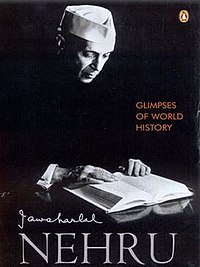
 Written by Nehru during his prison years in around 1930-1933 as letters to his daughter Indira, and published in 1938, Glimpses of World History is full of insights on all major civilizations from the days of Egypt, Mesopotamia, and India to the (then) present.
Nehru’s narration is completely different from typical history books you may find in the library and is bound to impress and enlighten anyone. Through his eloquent narration, added with modesty and simplicity, not only does he showcase prominent historical events but also adds reasoning and philosophies that help make sense of them. I find this book different from the rest, typically, in three aspects.
Firstly, Nehru takes into account of the lives of the masses at the bottom of the social pyramid: the working class and the slaves. All civilizations are, in essence, built by slaves – indigent, afflicted with privation, humiliation and travails in unimaginable scales. Although history is written by the noble and the gentry (who are of course well represented in the book), what is remarkable is the discussions on the lives of the general peasants and slaves and the hardship they had to go through.
Second, Nehru explains the events of the different contemporary civilizations together during each epoch and connects them. This provides readers with additional insight to make sense of historical events in a broader sense – not only when, who, what, and how they happened but also why.
Third, the book is full of discussions of all sorts of isms – capitalism, socialism, communism, anarchism, fascism, and so on, and how they entered different phases of the history. In this sense, it would be fair to call it a mix of history and sociology.
Highly recommended.
NOTE: beware at the same time it may not align with your taste for the book is also full of criticism towards capitalism and imperialism. Understandably Nehru is a truculent critic of the British imperialism and an avid admirer of Lenin and the Soviets. His predictions about the possibility of another big war with the rise of fascism in Europe did come out true in the form of World War II (remember this book was written in 1930s). But sympathies towards the Soviet-style rich society and the collapse of capitalism and democracy did not really materialize, well, not as of yet.